 Some time ago, my older brother Mans was working as editor of a Dutch magazine for university graduates. He pointed out one of the articles he had been working on, which dealt with the somewhat obscure subject of “cross-sensory experiences” known as Synesthesia.
At first glance, synesthesia appears to fall into the same category as telepathy, clairvoyancy and what not. Let’s face it: people who can hear colours or taste numbers are the kind of thing we hear about on late night radio chat shows, purely for entertainment – but not to be taken seriously.
As it turns out, there’s far more to synesthesia that meets the eye – or the ear, for that matter. It was a popular topic of research in the late 1800s, but then again, so was the idea of creating life through electricity. Largely abandoned in the 20th century, synesthesia has only recently returned to the radar of scientific research, which is how the article in my brother’s magazine came about.
Everyone is familiar with metaphors such as “loud colours”, “colourful language” or “bitter cold”. Appropriate as these descriptions may appear, for some people this mixup – or maybe enhancement – of the senses is an actual reality. The most widely experienced and researched form of this phenomenon appears to be grapheme-colour synesthesia, where the person perceives letters or numbers as having different colours. This is also a form which can easily be tested independently – unlike, say, lexical-gustatory synesthesia, where one associates different tastes with different words.
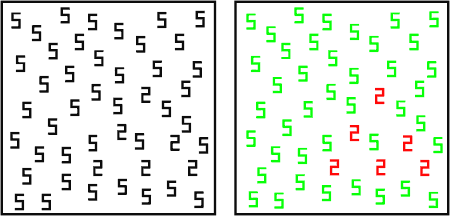
The tests for grapheme-colour synesthesia are very similar to those for colour blindness. The person is shown an image made up randomly arranged different letters or numbers. Certain identical numbers however, have been arranged in a recognisable pattern – which can only be easily perceived by someone who is a synesthete. In the simplified example shown here, a synthesist may see the black and white pattern shown on the left as something like that shown on the right.
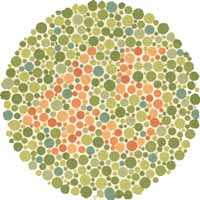 If you think that is strange or maybe even impossible, then consider the substantial proportion of the male population who, like myself, are partially or wholly colour blind. When we are presented with the familiar circular images that have a number or letter displayed by means of a differently coloured pattern, chances are that we simply see a bunch of dots, and nothing else – which is exactly what I see in the circle displayed here. Nothing. Somebody who does see the pattern that makes up the number 45 (apparently), is seeing something that does not exist, as far as I’m concerned. Only, in the case of us – the colour blind – we constitute a minority and the people who can see the hidden pattern are not considered strange. To suggest that colour blindness has anything to do with intelligence (as the ad for wixawin.com below does) is of course a completely different matter – but I digress.

Like the colour blind, people who have synesthesia do no consider themselves to “suffer” from a condition. It does not interfere with the person’s ability to function and it appears that synesthetes are born “that way” and only find out over time that their experience of the world around them differs from that of other people.
Once you start considering synesthesia as a reality, it seems to be a part of many people’s lives to a much greater extent that one would have thought. Just think about all those people who cannot bear the sound of fingernails scraping over a blackboard, for example. Why on earth would a simple sound make somebody feel physically uncomfortable? Goose bumps at the sound of beautiful music, the power of smell to evoke memories… Maybe these more familiar “cross-sensory” experiences are pointers to the more dramatic synesthesia experienced by only some of us.
There’s quite an extensive article on WikiPedia on this subject – for those who want to know more about what the days of the week taste like or what the colour red sounds like.